It was such a great experience from the moment we opened the Alpenwild website to the final goodbyes in Zermatt. Our guides were a fun, knowledgeable, energetic, all around fantastic team! The trek itself was completely as advertised and the assortment of accommodations made for a perfect overall experience. - D.A., Salt Lake City, UT
Hiking the Haute Route with Alpenwild is an unforgettable experience. Widely regarded as Europe’s most scenic trek, the Haute Route is a journey through the heart of the Alps. Alpenwild has more experience on this trail than any other outfitter, and our expert guides ensure your trek is not only safe and enjoyable, but deeply enriching.
Our small group approach allows you to travel like a local—with friends old and new, and in the company of someone who truly knows and loves these mountains. You’ll return home not only with incredible memories but also with greater strength, insight, and connection. Our priorities on every trip are simple:
Keep you safe
Ensure you have a great time
Help you do your best
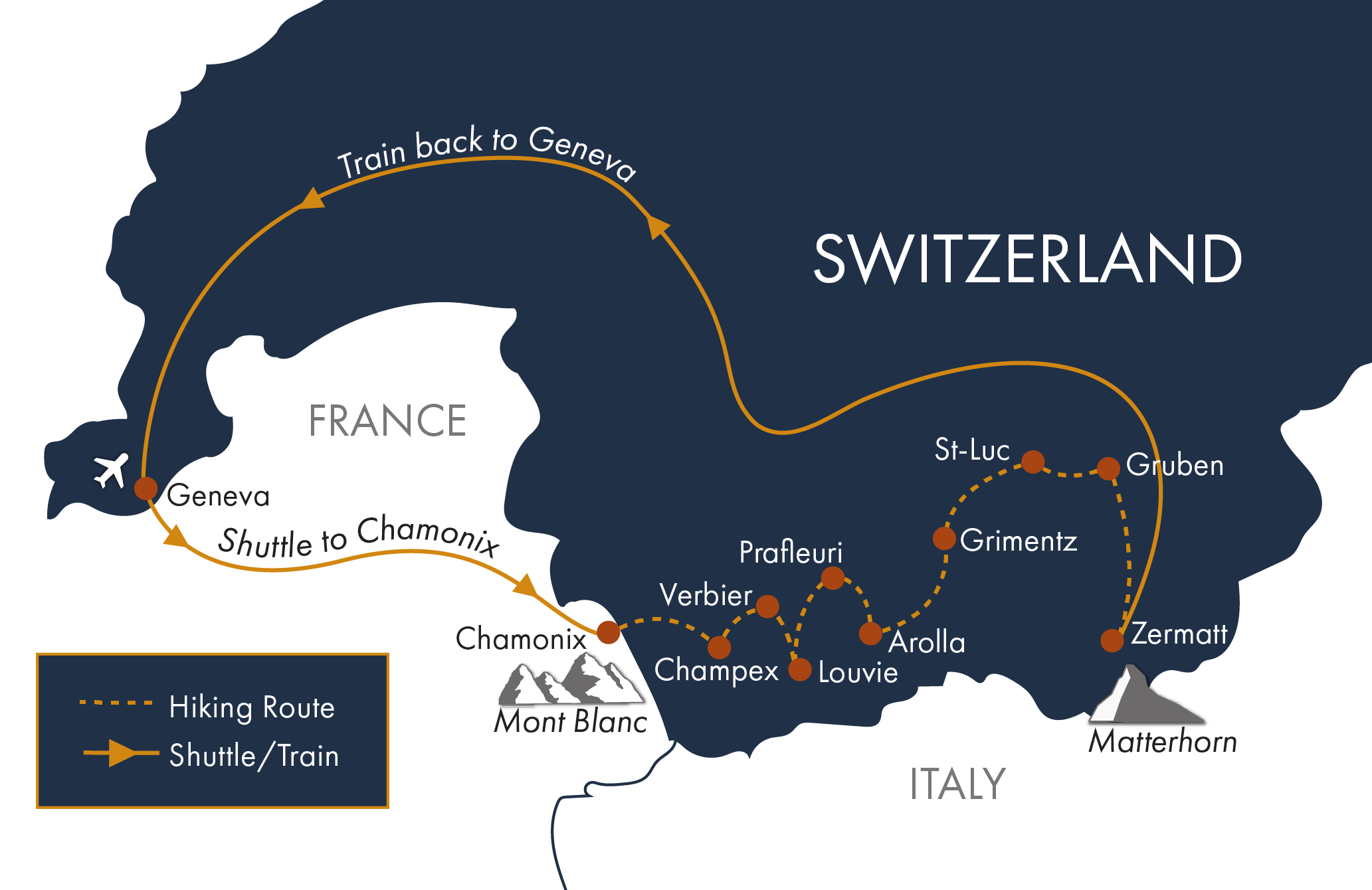
This trip includes two nights in mountain huts—typically at Louvie and Prafleuri. These huts offer a cozy group dormitory-style experience (shared rooms and bathrooms) with hearty meals in unforgettable alpine settings. The rustic accommodations will give you a chance to disconnect, reset, and take in the most stunning and remote landscapes on the Haute Route.
Yes. The Haute Route is one of our most challenging treks and best suited for hikers with previous experience. You should be in good physical condition and comfortable with 8 hours of hiking per day and daily elevation gains of 3,000–4,000 feet. If you’ve trained on steep terrain or taken long day hikes, you’re likely ready to enjoy this rewarding adventure.
Daily distances average about 9 miles per day. Some days are more, others are less. The typical pattern each day is steady ascent up to a pass, then steady descent on the second half of the day.
More than mileage, steep ascent and descent are typically what's most challenging about this trip. Also challenging is the fact that you'll be hiking for 10 days in a row, not counting your arrival and departure days. Exact distance and elevation stats are listed on each day’s itinerary. Stats may vary depending on your recording device, but these are a good estimate and reference point while training for this trip. If you have specific questions about the physical demands of the route, we’re happy to talk it through and help you find the best fit.
No technical climbing or special gear is involved. The Haute Route is a demanding hike, not a climb. There will be some exposed sections of trail, some boulder field crossings, and a section with chain on the rock to aid hikers up a steep and loose portion of trail. You do not need a harness, microspikes, or any technical gear. Good shoes and trekking poles will get you through. Sure footing, stamina, and a sense of adventure are your most important tools.
These terms often overlap. "Walking" is a general term for moving on foot. "Hiking" typically refers to walking on trails in nature. "Trekking" involves a multi-day journey on foot. The Haute Route is a true trek—one of the finest in the world.
Yes. This is a point-to-point trekking tour, which means each day involves hiking to reach the next hotel or mountain hut. Transportation to replace hiking is not included, so it’s important to be prepared to hike daily. We strongly recommend training ahead of time to ensure you’re ready for the physical demands of the route.
If you’re recovering from an injury or have concerns about your hiking ability, please let us know — we may be able to recommend a less strenuous tour for you.
In the event that you’re unable to hike one day, you’ll be responsible for covering the cost of your own transportation (such as a public bus or private taxi) to the next accommodation. Our guides can assist you with recommendations. Please note that riding with the luggage service is unfortunately not permitted, as drivers can be fined for taking passengers. Additionally, public transportation is not available between the mountain huts, which are only accessible on foot.
We’ll send a detailed packing list tailored to your trip. You’ll need to bring your own clothing, rain gear, daypack, and trekking poles. We provide all group gear—first aid, navigation tools, and trail snacks.
Luggage transfers are provided between hotels, so most days you’ll only need to carry a daypack with your essentials. While staying in huts (the Cabane de Louvie and the Cabane de Prafleuri), your main luggage won’t be accessible, so you’ll carry overnight items (like a change of clothes, toothbrush, and headlamp) for three days.
Plan to carry a few essentials: a change of clothes, headlamp, toiletries, a sleep sheet or liner, and a warm layer. We’ll provide a complete packing list before your trip.
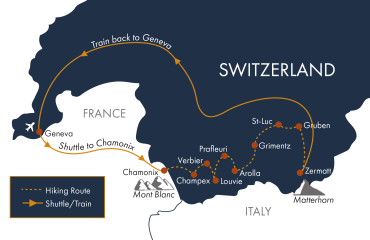
You'll want to fly into Geneva (GVA) to board the shuttle to Chamonix. It's just a 90-minute shuttle ride, included in your tour. From Zermatt at the end of the trip, you can fly out of Geneva or Zurich with the train ticket we provide. Both are about 4 hours from Zermatt by train.
Tour prices are based on double occupancy in a hotel room. If you prefer a private room or are traveling solo and don't want to be paired with a roommate, a single supplement covers the additional lodging cost.
Yes! Please let us know in advance if you are vegetarian, gluten-free, or have any specific allergies. Please keep in mind that the Swiss alpine diet relies heavily on dairy products, bread, and potatoes. It will be hard for some of your remote locations (like the mountain huts) to accommodate vegan diets.
We move at a pace that suits the group. Some guests like to hike faster and wait at scenic spots, while others prefer a more leisurely rhythm. Our guides ensure everyone enjoys the journey safely and comfortably.
Most hiking takes place between 3,000 and 8,000 feet, with daily pass crossings near 10,000 feet. If you're coming from sea level, you may feel winded at first. Headaches, nausea, or light fatigue are common at high altitudes and usually pass with rest or descent. Taking it slow the first few days can help.
Tap water in the towns and villages is safe and delicious. Alpine streams are generally safe too, and we’ve never had a reported issue. Still, for peace of mind, guides carry water purification tablets and you’re welcome to use them.
Our guided Haute Route groups are small, usually 6 to 12 guests. A tour needs a minimum of 6 guests to run, but will never exceed 14 guests. Even with just 9 guests, we often assign two guides. This allows for flexibility in pace and more personalized attention, making the journey more enjoyable for everyone.
Tips are appreciated but never required. Alpenwild guides work hard to ensure your experience is exceptional, and tips are a thoughtful way to express your gratitude. It’s customary to give your tip at the end of the tour.
"BSD" means that Breakfast, Snack, and Dinner are included that day. Our “snack” is actually a gourmet picnic lunch enjoyed on the trail—fresh bread, local cheese, meats, fruit, chocolate, and more. Dinners range from traditional hut fare to exceptional meals in locally-owned village restaurants. Guests often rave about the food!
We rate this trip as strenuous. You should be an experienced hiker in good physical condition. You should be capable of walking 6 to 9 hours per day on good, but rugged trails with steep ascents and descents (averaging 3,000 to 4,000 vertical feet per day) at an elevation up to 10,000 feet above sea level. Sure-footedness is important and if you have a history of severe vertigo, it may impact your ability to do this tour. Trekking poles are highly recommended.
Assume 2.5 miles/hour on the flat.
Assume 1200 feet of ascent per hour.
Assume 2000 feet of descent per hour.