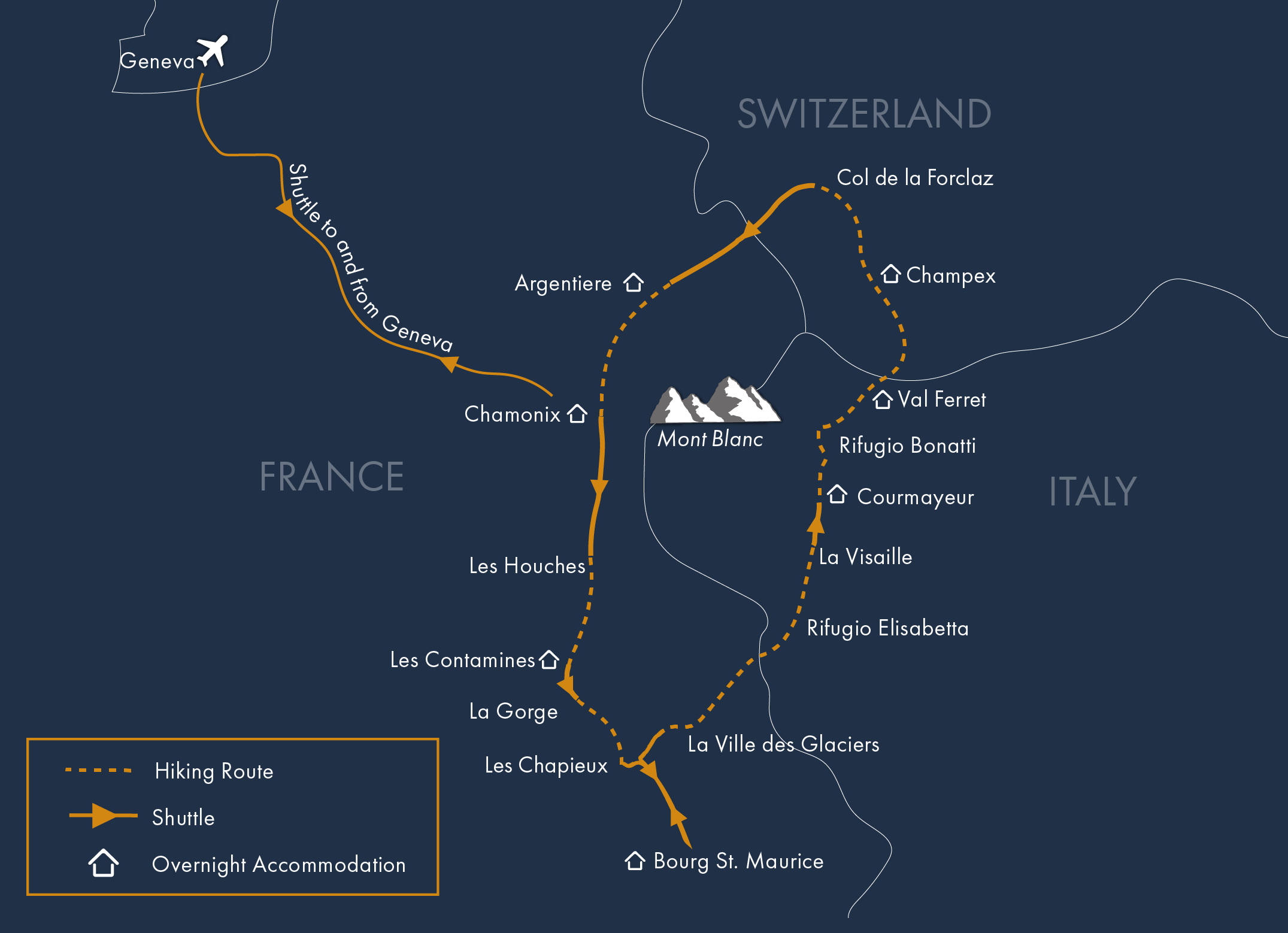
You’ll experience an empowering, supportive environment with like-minded women from around the world. Guided by UIMLA-certified female guides, the trek combines alpine adventure with luxury comfort.
Each evening, unwind in hand-picked boutique hotels with private rooms, hot showers, and gourmet meals. Explore three countries—France, Italy, and Switzerland—while enjoying safety, camaraderie, and personal attention every step of the way.
The Tour du Mont Blanc is a multi-day trek with significant elevation changes, so proper preparation is key to enjoying the experience. We recommend combining cardio, strength, and hiking-specific training:
Cardio: Build endurance with walking, hiking, running, or cycling 3–5 times per week. Gradually increase distance and intensity.
Hiking practice: Do hikes with elevation gain, ideally carrying a loaded daypack (10–15 lbs). Practice on trails with steep ascents and descents to simulate TMB terrain.
Strength training: Focus on legs, core, and balance—squats, lunges, step-ups, planks, and stability exercises help prevent fatigue and reduce injury risk.
Stamina: Plan for 6–8 hours of hiking at a steady pace, ideally on consecutive days, to prepare your body for back-to-back trekking.
With consistent training, you’ll be ready for daily elevation gains of 2,500–4,200 feet while hiking at altitudes up to 8,000–9,000 feet. Trekking poles are highly recommended, especially for descents and steep climbs.
Alpenwild keeps you informed every step of the way. You’ll receive two pre-tour newsletters with essential updates, packing reminders, and tips tailored for women hikers.
3–6 weeks before departure, you’ll get access to your personalized Vamoos portal, which includes your detailed itinerary, accommodation information, packing list, maps, and other essential trip details—all in one place for easy reference before and during your trek.
Yes. This is a point-to-point trekking tour, meaning each day (except your rest day) involves hiking to the next hotel. Transportation to replace hiking is not included, so daily hiking is required.
If you’re recovering from an injury or have concerns about your hiking ability, please contact us—our team can recommend a suitable alternative or provide guidance for preparation.
If you’re unable to hike a particular day, you’ll need to arrange and cover your own transportation—such as a bus, train, or private taxi—to reach the next accommodation. Your guides will gladly advise on the best options and help coordinate logistics.
Groups are small, generally 6–12 guests, fostering camaraderie and personalized guidance. For groups of nine or more, we provide two guides, allowing hikers to move at different paces while fully supported.
Minimum group size to run the tour is 6 guests.
Yes. Shared meals, scenic stops, and small group sizes foster meaningful connections. Many guests report lasting friendships formed on the trek.
The Single Supplement is an additional fee for guests requesting a private room, as standard pricing assumes double occupancy. Women traveling solo can request a private room for privacy and comfort with this supplement.
Yes. The women’s-only format provides a safe, supportive environment. You’ll hike with other women and experienced guides, giving peace of mind even if traveling alone.
Fly into and our of Geneva (GVA) for easy access to Chamonix. A 90-minute shuttle to Chamonix and back is included with your tour.
Tap water along the TMB is safe to drink. Most days, you’ll refill along the trail, but your guides will advise on which days to carry all the water you need.
Absolutely. Let us know in advance, and we’ll accommodate vegetarian, gluten-free, dairy-free, or other dietary needs. We’ve successfully supported countless women on the trail to ensure safe, delicious meals.
You’ll receive a detailed packing list before your trek. Essentials include hiking clothes, rain gear, and a comfortable daypack.
Alpenwild provides group gear such as trail snacks, first aid kits, navigational tools, and water purification if needed. Trekking poles are highly recommended, especially for descents and steep climbs.
Yes, prior experience with long day hikes in mountainous terrain is strongly recommended. While no technical skills are required, you should be able to handle daily ascents of 3,000–4,000 feet and hikes averaging 7–12 miles.
No. The Deluxe TMB is a trekking route, not a mountaineering route. You may encounter short sections requiring hands for balance, but no ropes, harnesses, or climbing experience are needed.
The Deluxe TMB is designed to be challenging but achievable for fit hikers. Some stages allow optional shortening via local transport (cable car or public bus), but full days cannot be skipped.
We rate this trip as strenuous, requiring 6–8 hours of hiking per day on trails with 2,500–4,200 feet of ascent and descent. Trekking poles are strongly recommended.
Typical pacing:
Flat terrain: ~2.5 miles/hour
Ascent: ~1,200 feet/hour
Descent: ~2,000 feet/hour
Example distances and elevations are available on Alpenwild’s AllTrails page.
Absolutely. While the group moves together in the morning, guides encourage individual pacing. Women can take breaks, enjoy the scenery, or challenge themselves as they wish.
Guides are trained to assist with pacing, minor injuries, and equipment. If needed, local transport options can help shorten a stage, though guests are responsible for transport costs.
Most hiking occurs between 4,000–7,000 feet, with mountain passes reaching ~8,300 feet. Mild symptoms like shortness of breath or fatigue may occur but serious altitude effects are uncommon.
Arriving a day early in Chamonix helps your body adjust and recover from travel.
No. Daily luggage transfers are included, so you carry only a light daypack. Your main luggage awaits you at each hotel. This is especially convenient on the Deluxe TMB, where all nights are in hotels—no hut stays are required.
On the Tour du Mont Blanc, you’ll spend long hours hiking through alpine terrain, so it’s helpful to know how to handle bathroom breaks outdoors.
For women, this is normal and doable! Here are some tips:
Use trail-side breaks when possible: Look for discreet areas off the trail with natural cover.
Carry toilet paper or wipes: Always pack out used toilet paper in a small zip-lock bag or wet wipes, following Leave No Trace principles.
Consider a pee device: Many women use a female urination device (FUD), which lets you stand comfortably when nature calls.
Plan breaks at huts and restaurants: Most days you’ll pass small villages, refuges, or rest stops where toilets are available.
Guides will also point out safe spots and help make the experience stress-free. Outdoor bathroom breaks are part of the alpine adventure, and with a little preparation, you’ll manage just fine while staying clean and comfortable.
We rate this trip as strenuous, with limited adaptability and vehicle support. You should be an experienced hiker in good physical condition. You should be capable of walking 6 to 8 hours per day on good trails, with some steep ascents and descents averaging 2,500 to 4,200 vertical feet per day at an elevation up to 9,000-10,000 feet above sea level. Trekking poles are highly recommended.
Assume 2.5 miles/hour on the flat.
Assume 1200 feet of up per hour.
Assume 2000 feet of down per hour.
See Alpenwild Alltrails for example statistics (may vary).