
The Bernese Oberland Traverse is typically considered a strenuous hike and can be quite demanding depending on the section and your pace. Hikers should be in good physical condition, have experience navigating mountain terrain, and be comfortable with long climbs and descents. The use of trekking poles is recommended, and following a training plan emphasizing endurance, strength, and hiking-specific fitness is highly encouraged.
Daily distances: 7–10 miles
Duration: 7–8 hours per day
Elevation gain and descent: Moderate, often up to 3,000-4,000 feet per day, with some higher points reaching over 9,000 feet
Terrain: The route follows well-maintained alpine trails, though some sections are steep and physically demanding. Hikers should be prepared for changing alpine weather and uneven, rocky terrain. In particular, areas such as the Seffinenfurga and Hohtürli passes include exposed stretches and long stair sections.
Yes! The full Swiss Via Alpina route spans from Sargans to Montreux, comprising approximately 19 stages. We divide the route into two tours:
Luggage transfers are provided throughout the Bernese Oberland Traverse, ensuring your main bags are transported between hotels while you hike with only the essentials. You’ll need to travel with your luggage to get to and from the tour. We recommend bringing a daypack with a hip belt for carrying daily necessities such as rain gear, water, and snacks.
Each guest is allowed one checked-size suitcase (up to 20 kg / 44 lbs). If you plan to bring more than one bag per person, please inform us in advance, as additional luggage fees apply.
Yes — this is a point-to-point trekking tour, meaning that each day (except for your rest day), you’ll hike from one hotel to the next. If you prefer not to hike on a given day, you can instead use public transportation or take a taxi to reach your next destination.
We strongly recommend training beforehand to prepare for the physical demands of the route. If you have any concerns about your hiking ability, please let us know — we can often suggest a less strenuous alternative tour.
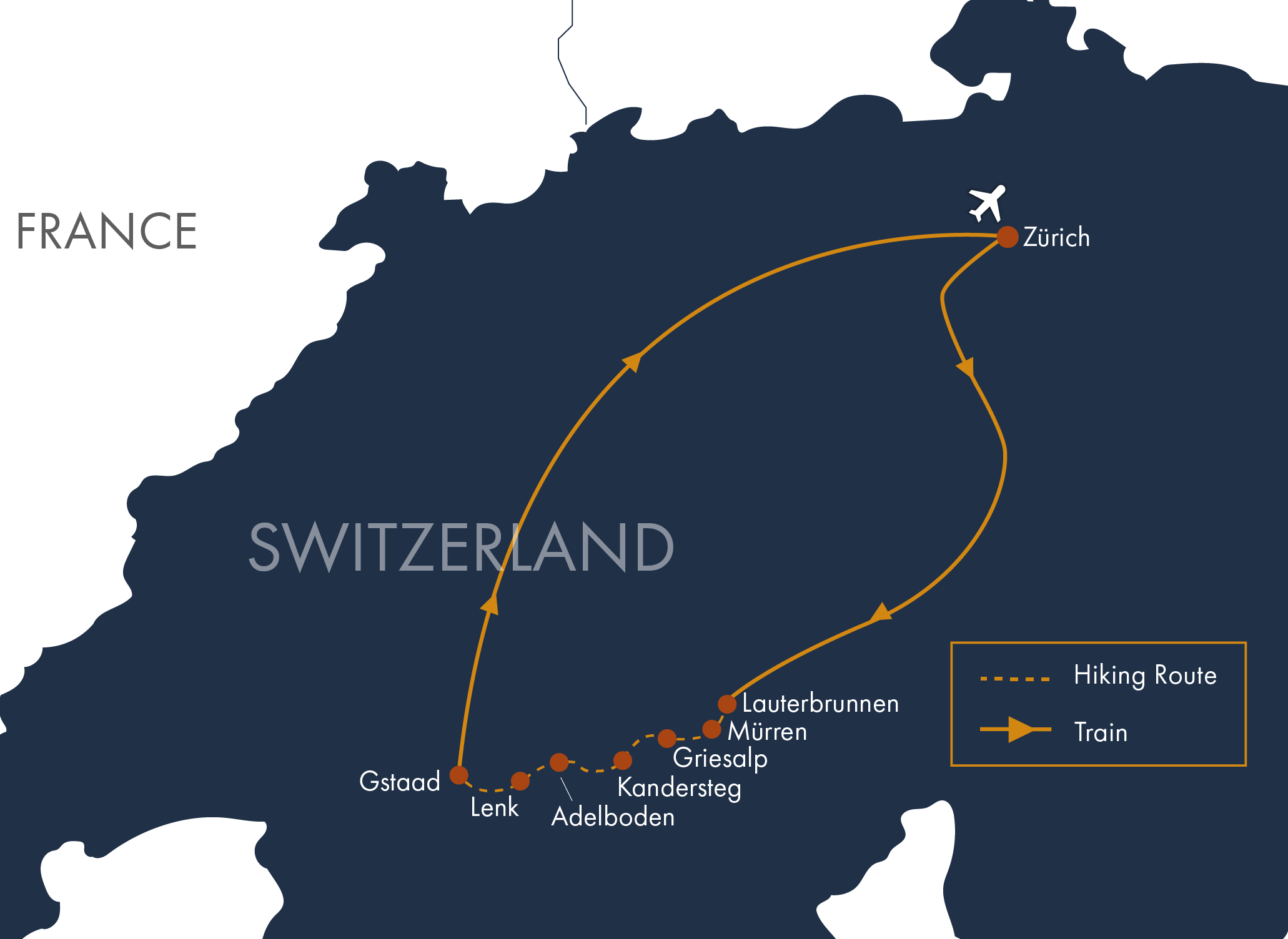
Yes! On this tour, there are three occasions where you stay two nights at certain hotels (Griesalp, Kandersteg, and Gstaad). If you prefer, we can remove these extra nights, creating a 7-night/8-day itinerary that still includes all the same hikes between villages.
The self-guided Bernese Oberland Traverse tour includes a buffet breakfast each morning at the hotels. Lunches are not included, but we will provide suggestions for where to purchase picnic supplies or which mountain hotels you can dine at along the route. The tour includes five dinners, typically three-course set menus. Drinks are not included, so these will need to be paid for separately. On evenings when dinner is not provided, we will offer recommendations for nearby restaurants.
While Swiss cuisine is generally dairy-focused, we can accommodate most dietary requirements, including gluten-free, vegetarian, and lactose-free diets. Vegan options are limited and are not available at Hotel Griesalp, where a vegetarian meal will be offered instead. Please inform us in advance of any dietary restrictions or allergies so we can notify the hotels and make appropriate arrangements.
The hotels on this tour are typically family-run, offering traditional Alpine charm and comfortable accommodations. All rooms are private with en-suite bathrooms. Here are a few additional details to keep in mind:
The single supplement is an additional charge for travelers staying in a single-occupancy room, meaning solo travelers will need to pay this fee. Tour prices are based on double occupancy, where the cost of a hotel room is shared between two guests. When a room is used by only one person, the single supplement covers the full room cost. It also includes luggage transfer services for solo hikers, as these transfers are priced based on a minimum of two participants.
Switzerland’s currency is the Swiss Franc (CHF). ATMs, commonly found at banks, grocery stores, and train stations, usually provide the best exchange rates. While credit cards are widely accepted in shops and restaurants, it’s advisable to carry some cash for buses, taxis, smaller cable cars, and mountain restaurants where cards may not be accepted.
We rate this trip as strenuous. You should be an experienced hiker in good physical condition. You should be capable of walking 7-8 hours per day on good trails with some steep ascents and descents, averaging 2500-4500 vertical feet per day at an elevation up to 8500 feet above sea level. Sure-footedness is important and vertigo may impact your ability to do this tour. We cross two of the most spectacular and challenging hiking passes in the Swiss Alps—the Sefinenfurgge and the Hohtürli. On these passes, there are long staircases, scree slopes, some exposed drop-offs protected by cables or handholds, and short ladder assists of about 2 meters. You’ll want to be a sure-footed, experienced hiker with a head for heights. Please note that there are three days during this tour with elevation gains between 3700 and 4400 vertical feet.
Assume 2.5 miles/hour on the flat.
Assume 1200 feet of up per hour.
Assume 2000 feet of down per hour.