
The Eiger to Matterhorn trekking tour in Switzerland is generally considered strenuous, depending on your fitness level and the section of the trail.
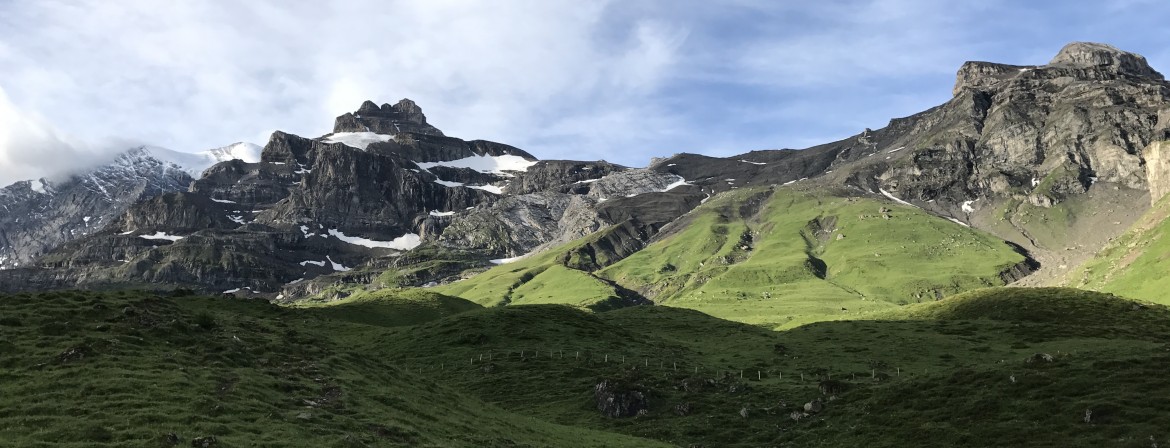
Terrain: Mostly well-marked alpine trails, but includes steep ascents and descents, uneven rocky paths, and some exposed sections.
Elevation: Daily hikes often involve significant elevation gain and loss, sometimes 2300–4,000 feet per day.
Distance: Average hiking distances range from 5–11 miles per day, depending on the route.
Experience Level: Recommended for experienced hikers comfortable with mountain terrain and long, sustained hiking days.
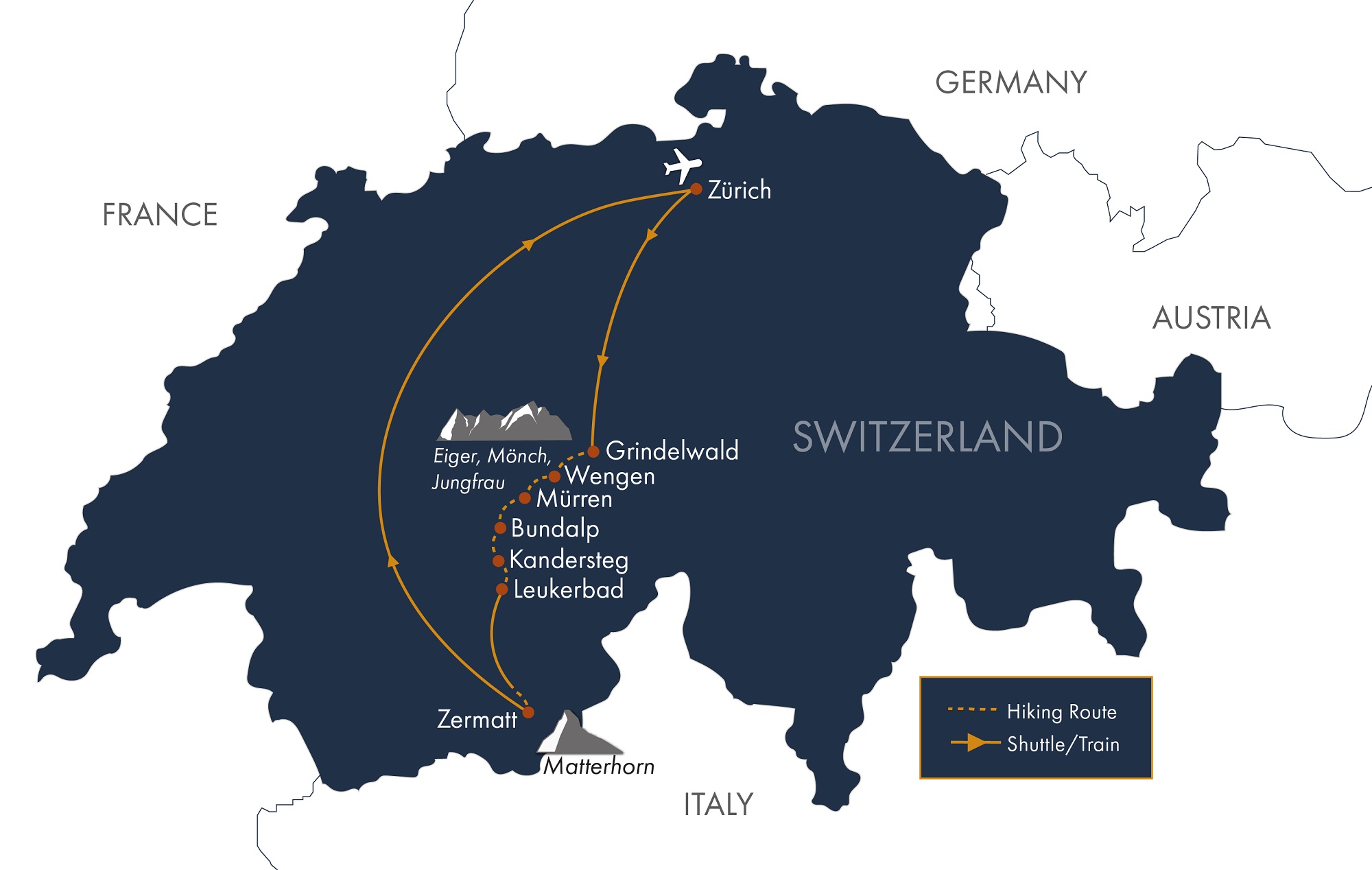
The Eiger to Matterhorn tour begins in Grindelwald, home to the iconic Eiger Mountain, and concludes in Zermatt, at the foot of the legendary Matterhorn. Along the way, you will hike from village to village, reaching Leukerbad, from where you will take the train onward to Zermatt.
Yes! On our self-guided Eiger to Matterhorn tour, luggage transfers are included between all hotels. You only need to carry your daypack with essentials such as water, snacks, and rain gear.
Each guest may bring one checked-size suitcase (maximum 20 kg / 44 lbs). If you wish to bring extra luggage, please inform us ahead of time, as additional fees will apply.
This is a point-to-point trekking tour, which means that each day (except for your rest day in Griesalp) you will hike from one hotel to the next. Please note that the journey from Leukerbad to Zermatt is by train, with a recommended stop in Randa for a short hike before continuing to Zermatt. If you prefer, you can skip this optional hike and travel directly to Zermatt.
If you’d rather not hike on a given day, you have the option to take public transportation or a taxi to your next destination.
Yes, all breakfasts are included at the hotels, along with five dinners. The dinners at the hotels are typically 3-course set menus, and drinks are excluded and must be purchased separately. For the evenings when dinner is not provided, we will offer recommendations. Lunches are typically picnics or enjoyed at a mountain hotel restaurant, and we will provide suggested options for these as well.
We can accommodate most dietary needs, including gluten-free, vegetarian, and lactose-free diets. Vegan options are limited and not available at Hotel Griesalp, where a vegetarian alternative will be provided instead. Please let us know in advance about any dietary restrictions or allergies so we can inform the hotels and ensure proper arrangements.
We stay in smaller 3- and 4-star hotels on this tour that offer Swiss charm, hospitality, and comfort, often in picturesque alpine villages with scenic mountain views. These family-run hotels provide private rooms with en-suite bathrooms, hearty local cuisine, and a cozy atmosphere perfect for relaxing after a day of hiking.
The single supplement is an extra fee for travelers staying in a single-occupancy room, so solo travelers will need to pay this charge. Tour prices are based on double occupancy, with the cost of a hotel room shared between two guests. When a room is occupied by only one person, the single supplement covers the full cost of the room. It also includes luggage transfer services for solo hikers, since these transfers are calculated based on a minimum of two participants.
We rate this trip as strenuous. You should be an experienced hiker in good physical condition. You should be capable of walking 5 to 7 hours per day on good trails with some steep ascents and descents (averaging 2,000 to 3,300 vertical feet per day) at an elevation up to 10,000 feet above sea level. You will cross two of the most spectacular and challenging hiking passes in the Swiss Alps—the Sefinenfurgge and the Hohtürli. On these passes, there are long staircases, scree slopes, some exposed drop-offs protected by cables or handholds, and short ladder assists of about 2 meters. You’ll want to be a sure-footed, experienced hiker with a head for heights . Please note that there are two days during this tour with elevation gains between 3300 and 4600 vertical feet.
Assume 2.5 miles/hour on the flat.
Assume 1200 feet of up per hour.
Assume 2000 feet of down per hour.